

(By Subash Sadasivan)
In a powerful tribute to both Rabindranath Tagore (1861-1941) and the ongoing struggle for gender equality, a new stage adaptation of the great Bengali poet’s work premiered in East Ham to critical acclaim.
The play, a re-interpreted version of Tagore’s 1901 novella Nastanirh (The Broken Nest), presented by Guruprabha, was staged on 15th March 2026, at the Sree Narayana Guru Mission of the UK centre as part of the Mother’s Day and International Women’s Day celebrations, forming an emotional and spiritual centrepiece for this year’s International Women’s Day celebrations.
Adapted and directed by Manoj Shiva, an acclaimed London-based artist, the production brings the timeless tensions of Tagore’s narrative into a sharp contemporary focus. While the original story is known to global audiences through Satyajit Ray’s 1964 cinematic masterpiece Charulatha, Manoj Shiva, in his adaptation, seeks to amplify its distinctly ‘feminine’ relevance for IWD 2026.

Set against the backdrop of the late 19th-century Bengal Renaissance, the narrative explores the emotional confinement of its central character, Charu, within an upper-class household. Her husband, Bhupathi, is a progressive intellectual consumed by his political journal, yet he remains regressively traditional in his domestic life, treating his wife as a decorative object rather than an intellectual equal. In the original novella and film, her loneliness is briefly alleviated by the arrival of her cousin-in-law, Amal, who encourages her hidden literary talents. However, in the new drama, these events are subtly replaced by Charu’s dream sequences, consisting of music and dance, where metaphorically, this ongoing kinship blurs the lines between creative companionship and forbidden intimacy, ultimately leaving Charu in a state of devastating isolation.

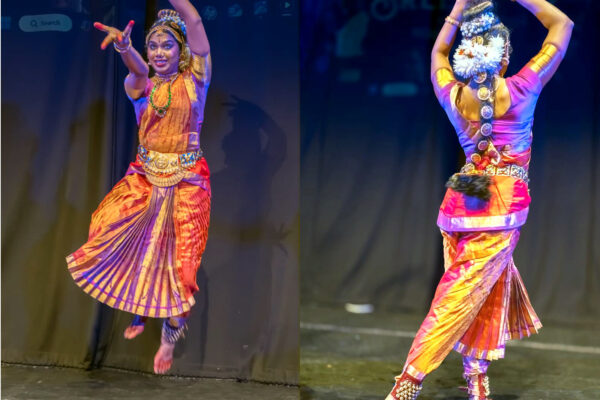
After scripting and directing in the last 25 years in the UK, of many dramas like Kanthi, Swathivedam, Gurubrahma, Manoj has crafted a production that balances emotional subtlety with dramatic intensity. Despite a condensed rehearsal schedule, the hour-long performance demonstrated remarkable professionalism. The audience, filling the hall, remained silent and spellbound throughout, captivated by a cohesive blend of precise acting, good musical scores with lyrics by Meera Manoj, and meticulously choreographed movement by Seema. Seema’s powerful dances, wearing wings, reminiscent of Tagore’s poem “The Tame Bird was in a Cage”, are metaphorical, exploring the fundamental dualistic separation between freedom and bondage. The effectiveness of the production was further enhanced by Thasneem’s clever stage design, which evoked the claustrophobic elegance of a colonial-era drawing-room. Lighting by Subhash Pillai and sound coordination by Prakash Damodaran were excellent.
At the heart of the play’s success was Manju Mandirathil’s deeply felt portrayal of Charulata ( Charu). She embodied the “New Woman” of colonial India, intellectually curious and creatively suppressed, yearning for attention and recognition beyond her domestic sphere. Her performance skilfully charted Charu’s descent from hopeful self-realisation to profound despair, a journey that served as a stark reminder of the emotional neglect still faced by many women globally.
The supporting cast delivered equally compelling performances. Nash Rawther portrayed Bhupathi with a precise aloofness, perfectly capturing a man blind to the devastation his neglect causes. Manoj Shiva himself took on the role of Amal, bringing a layered complexity to the character whose encouragement inadvertently deepens Charu’s tragedy. Rittu Sunil played Mandakini, a relative unable to comprehend Charu’s world, while Sasikumari Jyothiprakash represented the fixed and established patriarchy as the family elder who insists women remain confined to traditional duties.

In a creative narrative flourish, Satheesh Kumar appeared as the visionary figure of Rabindranath Tagore himself. In the play’s final moments, Tagore addresses the audience directly, reflecting on the “Broken Nest” as a metaphor for the failure of domestic space to provide emotional sanctuary. He dissects the blurred lines between kinship and love, highlighting the shared tragedy of both Charu and Bhupathi.

Ultimately, this SNGMUK production transcended its period setting to pose a vital, modern question. It challenged the audience to consider why, over a century later, so many women remain “showpieces” in their own lives rather than equal partners. By holding a mirror to the past, Manoj Shiva’s Charulatha offered a stirring and essential commentary on the relationships between men and women in the present day.






Leave a Reply